On this page
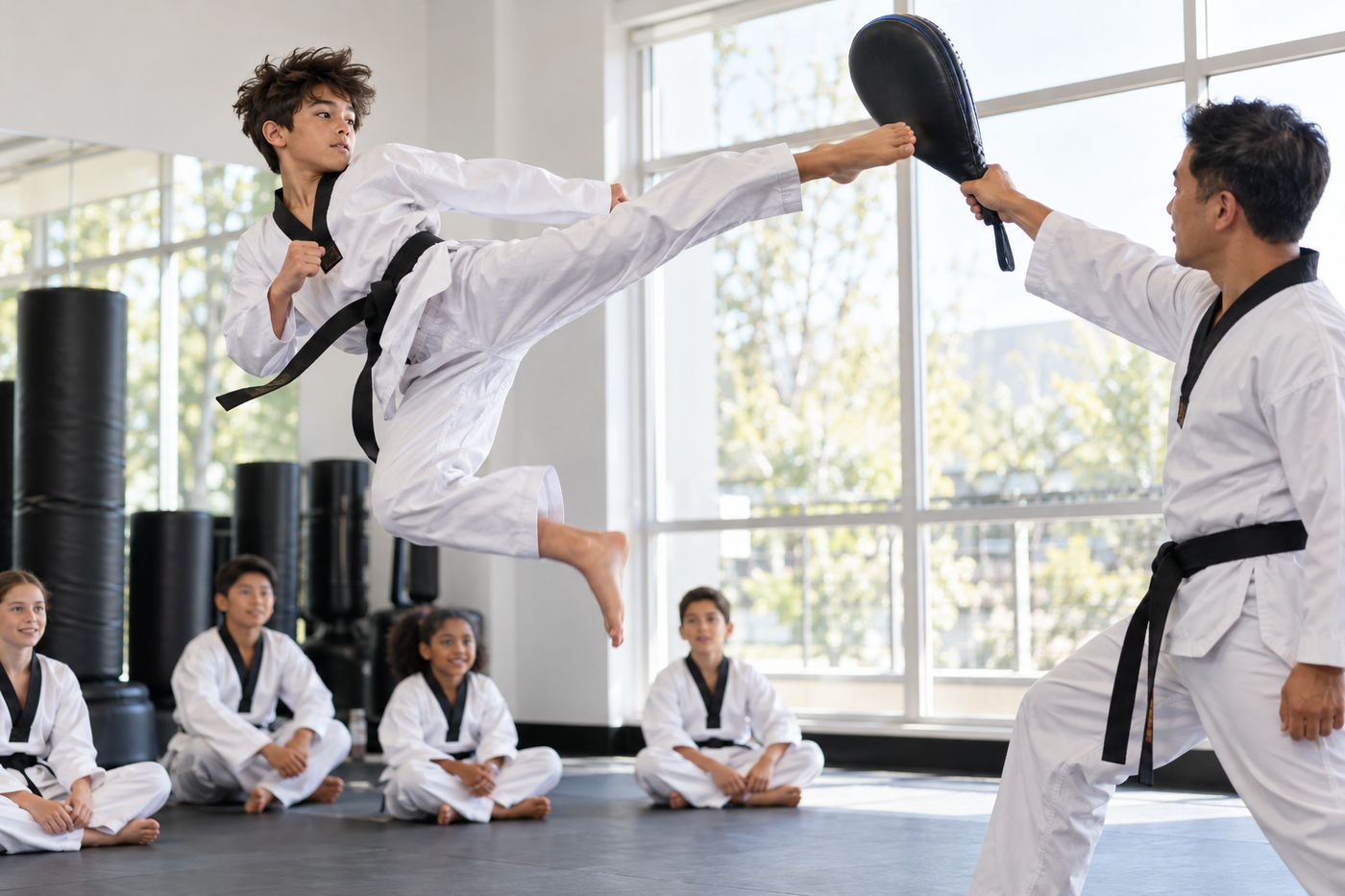
The jumping front kick, ttwieo ap chagi (뛰어앞차기), takes the first kick every student learns and lifts it off the ground. It is a red belt staple, because the eighth Taegeuk form, Taegeuk Pal Jang, opens with a double jumping front kick and has a single one in its second half, and examiners watch both closely. It is also a classic breaking kick for boards held high. Done well, it looks light and explosive. Done badly, it looks like a hop.
What the jumping front kick is used for
In forms, the jumping front kick and the double jumping front kick (dubal dangseong ap chagi, 두발당성앞차기) appear in Taegeuk Pal Jang. In breaking, the jumping front kick is used to reach a board held above head height. In sparring it is rare, because jumping straight at an opponent leaves you exposed, but the knee drive it teaches helps every jumping kick.
How to do a jumping front kick, step by step
- Start in a front stance or fighting stance, guard up.
- Drive the back knee up hard, as if starting a front kick. This knee lift starts the jump.
- Push off the standing foot and leave the floor.
- While in the air, bring the other knee up and snap a front kick with it, striking with the ball of the foot.
- Land on the first leg, then the kicking leg, in a balanced stance with your guard up.
For the double jumping front kick, the first knee does more than lift: it snaps a front kick of its own, and the second leg kicks while you are still in the air. In Taegeuk Pal Jang this is done with a gihap, and you land in a front stance ready for a block.
Common mistakes
Jumping without the knee drive is the most common error. The kick ends up low and the jump looks flat. The knee drive is the jump.
The second is kicking on the way down. The kick should land at the top of the jump. Time the kick with the highest point. Third, students often land heavily with straight legs, which is hard on the knees and looks uncontrolled. Bend the knees and land softly. Last, the hands often fly up as you jump. Keep the guard tight.
Drills to practise at home
Knee drives. Stand on one leg and drive the other knee up hard ten times, then switch. Add a small hop as the knee rises.
Skip kicks. Skip forward and throw a front kick at the top of each skip. This builds the timing.
Low jumping kicks. Practise the full kick at waist height, focusing on kicking at the top of the jump and landing softly.
Form practice. If you are working on Taegeuk Pal Jang, practise the opening double jumping front kick on its own, then in the form. See our step-by-step guide to Taegeuk Pal Jang.
Where it fits in your training
The jumping front kick is usually learned around red belt, for Taegeuk Pal Jang. It builds on the front kick. For other jumping kicks, see the jumping side kick and the jumping back kick, and for every kick, the kicks guide.
Questions parents and students ask
Which form has the jumping front kick?
Taegeuk Pal Jang, the eighth form, which has a double jumping front kick at the start and a jumping front kick in the second half. Both are performed with a gihap.
What is the difference between a jumping front kick and a double jumping front kick?
In a jumping front kick, one leg kicks in the air. In a double jumping front kick (dubal dangseong ap chagi), the first leg's knee lifts or kicks to drive the jump, and the second leg kicks while you are still in the air.
How do I get higher on jumping kicks?
Drive the non-kicking knee up hard as you jump. Most of the height comes from that knee lift, not from pushing off the floor.