On this page
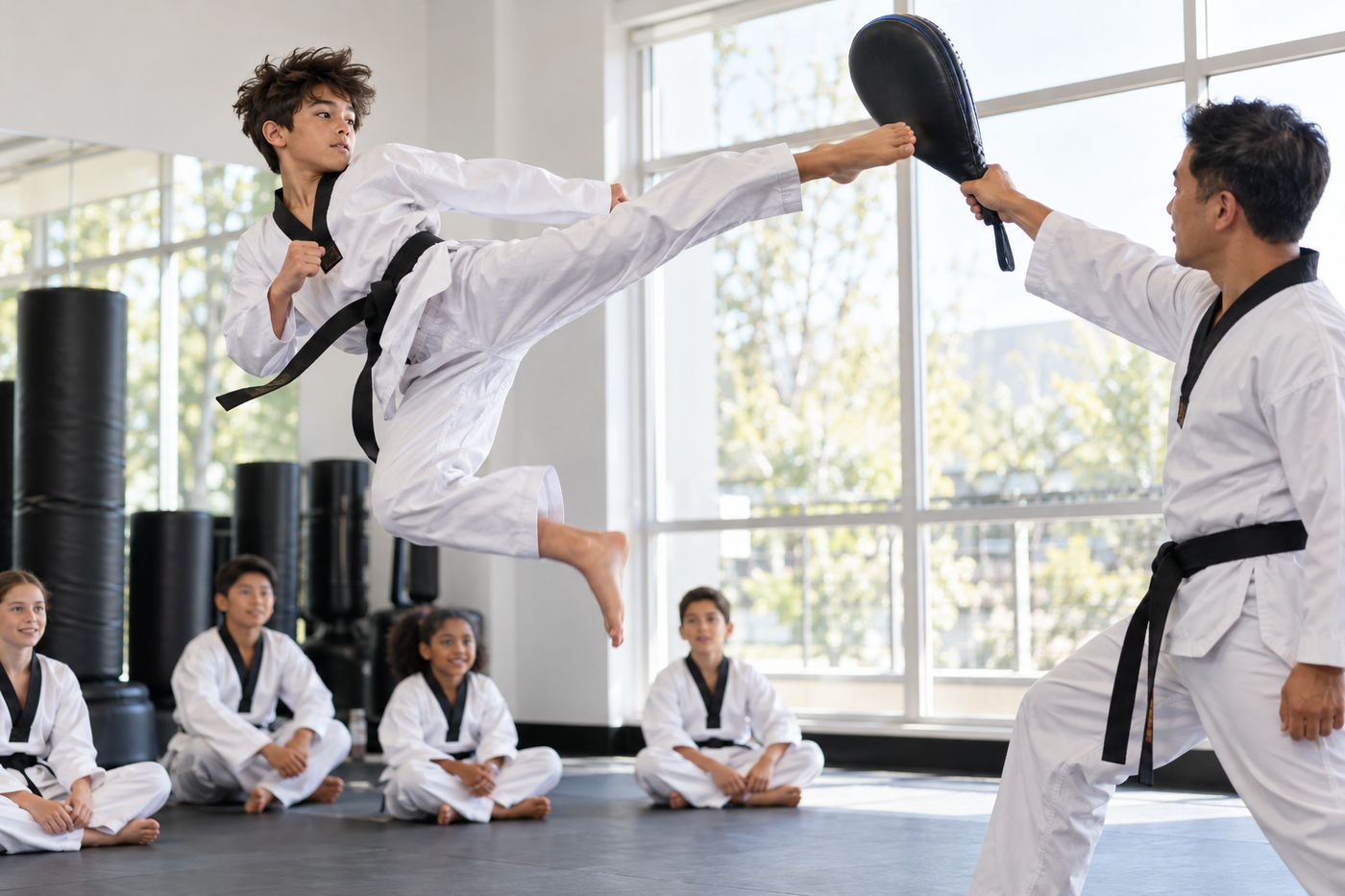
The jumping back kick, ttwieo dwi chagi (뛰어뒤차기), is the back kick with lift-off. The student turns away from the target, jumps, and drives the heel straight back at the top of the jump, landing facing forward. It is one of the most powerful kicks in Taekwondo, a regular in breaking demonstrations and a dangerous counter in sparring. Like every advanced kick, it is only as good as the basic kick it is built on.
What the jumping back kick is used for
In breaking, the jumping back kick goes through boards held at chest or head height with the full rotating weight of the body. In sparring, it is a counter against an opponent who charges in, and it scores as a turning kick. It is also a common requirement at higher belt tests, often on a held board.
How to do a jumping back kick, step by step
- Start in a fighting stance, side-on to the target, guard up.
- Turn your head and look over your back shoulder at the target.
- Start turning your body away from the target and drive the front knee up to lift into the jump.
- Jump and continue turning so your back faces the target in the air.
- Drive the heel of the kicking leg straight back to the target, toes pointing down, at the top of the jump.
- Pull the leg back and land facing the target, on the non-kicking foot first, with your knees bent and guard up.
The kicking leg should brush close to the other leg on its way out, just like a standing back kick. A wide swing will miss.
Common mistakes
Jumping before turning the head is the most common error. If you cannot see the target, you cannot hit it. Spot it first.
The second is over-rotating in the air, which turns the kick into a sideways swipe. Stop the turn when your back faces the target. Third, students often kick on the way down, losing the power of the jump. Time the kick with the top of the jump. Last, landing with your back to the target or on stiff legs leaves you exposed and risks injury. Finish the turn and land softly.
Drills to practise at home
Standing back kicks. Make sure the floor-level back kick is accurate and straight. See the back kick guide.
Turn and hop. Practise the head turn, body turn and a small hop, landing facing forward, without kicking. Ten each way.
Low jumping back kicks. Do the full kick at waist height with a small jump, focusing on the straight line of the heel.
Landing practice. Small jumps landing softly on one foot then the other. Good landings protect the knees.
Spinning jump kicks are best practised on mats with an instructor nearby, and only after a full warm-up.
Where it fits in your training
Most students learn the jumping back kick around red belt, after the standing back kick is solid. For the other spinning and jumping kicks, see the jump spinning hook kick and the tornado kick, and for every kick, the kicks guide.
Questions parents and students ask
What is a jumping back kick?
A back kick thrown in the air. The student spins, jumps and drives the heel straight back into the target at the top of the jump. It is mostly used in breaking and as a powerful counter in sparring.
Is it harder than a regular back kick?
Yes. The turn, the jump and the kick have to happen in one motion, and landing facing the target after a spinning jump takes balance. A solid standing back kick comes first.
Does a jumping back kick score more in sparring?
It scores as a turning kick, which earns extra points under World Taekwondo rules: 4 to the body and 5 to the head. The jump itself does not add points.