On this page
Red belt is the final color before black, and in most schools it is the longest and hardest stage of the color belts. A red belt knows nearly everything a first-degree black belt needs to know. What remains is polish, stamina and maturity, and instructors take their time making sure all three are there before inviting a student to the black belt test. If your child has just tied on a red belt, the road to black belt is in sight, but it is not a short one.
What the red belt symbolizes
Red is the color of danger and caution. The traditional explanation is that a red belt student now has real skill, enough to injure someone, and must learn to control it. The red is a warning to the student as much as to an opponent: think before you act, and use what you know responsibly.
Some schools add a second meaning, linking red to the sun, the brightest point of the day just before evening. Either way, red is about power that has to be managed, and that idea runs through everything a red belt is asked to do.
The attitude expected at red belt
The defining quality of red belt is self-control, what Korean instructors sometimes call geukgi. A red belt is expected to spar hard but cleanly, never losing their temper or hitting harder than the drill calls for. They are expected to stay calm when tired, when corrected and when a technique will not come right.
Humility is the other half. Red belts are often the senior students in a class, and the instructor watches closely for arrogance. A red belt who helps without showing off, accepts correction gracefully and treats beginners kindly is showing exactly the maturity a black belt needs. Many schools ask red belts to assist regularly and some require a set number of teaching hours before the black belt test.
What a red belt learns
Red belt training is a mix of one new form, advanced kicks and a lot of review:
Taegeuk Pal Jang, the eighth and final Taegeuk form, with a double jumping front kick, slow pulling uppercuts, tiger stances and elbow strikes. See our step-by-step guide to Taegeuk Pal Jang.
Advanced jumping and spinning kicks (idan chagi and others), including jumping back kicks and spinning hook kicks, often used in breaking demonstrations.
Review of all eight forms. Black belt tests can ask for any Taegeuk form, so red belts spend much of their time going back over forms one to seven.
Self-defense against grabs, punches and sometimes multiple attackers, depending on the school.
Conditioning. Black belt tests are long, and red belts build stamina with longer sparring rounds and fitness work.
How students prepare for the black belt test
Most schools split red belt into stages. A common pattern is red belt, then red with a black stripe, then a red-black or “black stripe” belt for students who have been formally recommended for the black belt test. Each stage has its own requirements, and the last one is usually a period of focused preparation, sometimes with a pre-test.
The black belt test itself usually covers all eight Taegeuk forms (the examiners choose which ones), basics, kicking combinations, self-defense, several rounds of sparring and breaking. Many schools add an essay, an interview or a talk about what Taekwondo means to the student. If the test is for a Kukkiwon certificate, the student also needs to meet the age rule: under 15 they test for a poom, 15 and over for a dan.
How long red belt takes
Red belt usually takes six months to a year, and sometimes longer for students who train once a week. This is by design. Schools that rush students through red belt tend to produce black belts who are not ready, and most instructors would rather wait.
Tips for parents and students
For parents, the main thing at red belt is patience. The visible rewards slow down just as the effort goes up, and it helps to talk openly with your child about how long the stage takes at your school. Asking the instructor for a written list of black belt requirements gives everyone a clear target.
For students, the best preparation is regular, honest review of the earlier forms. Pick one form each day and perform it slowly, checking every stance, before running it at full speed. The test is long, so practise doing several forms back to back.
Next comes the black belt. For the full ladder of ranks and the official black belt age rules, see Taekwondo ranks explained.
Questions parents and students ask
What does red belt mean in Taekwondo?
Red stands for danger and caution. The student now has skill that could hurt someone, and must learn the self-control to use it responsibly. It is the last color belt before black.
How long does it take to go from red belt to black belt?
Usually six months to a year. Many schools split red into two or three stages, such as red, red with a black stripe and red-black, and expect the student to know all eight Taegeuk forms well before testing.
Is red higher than black in Taekwondo?
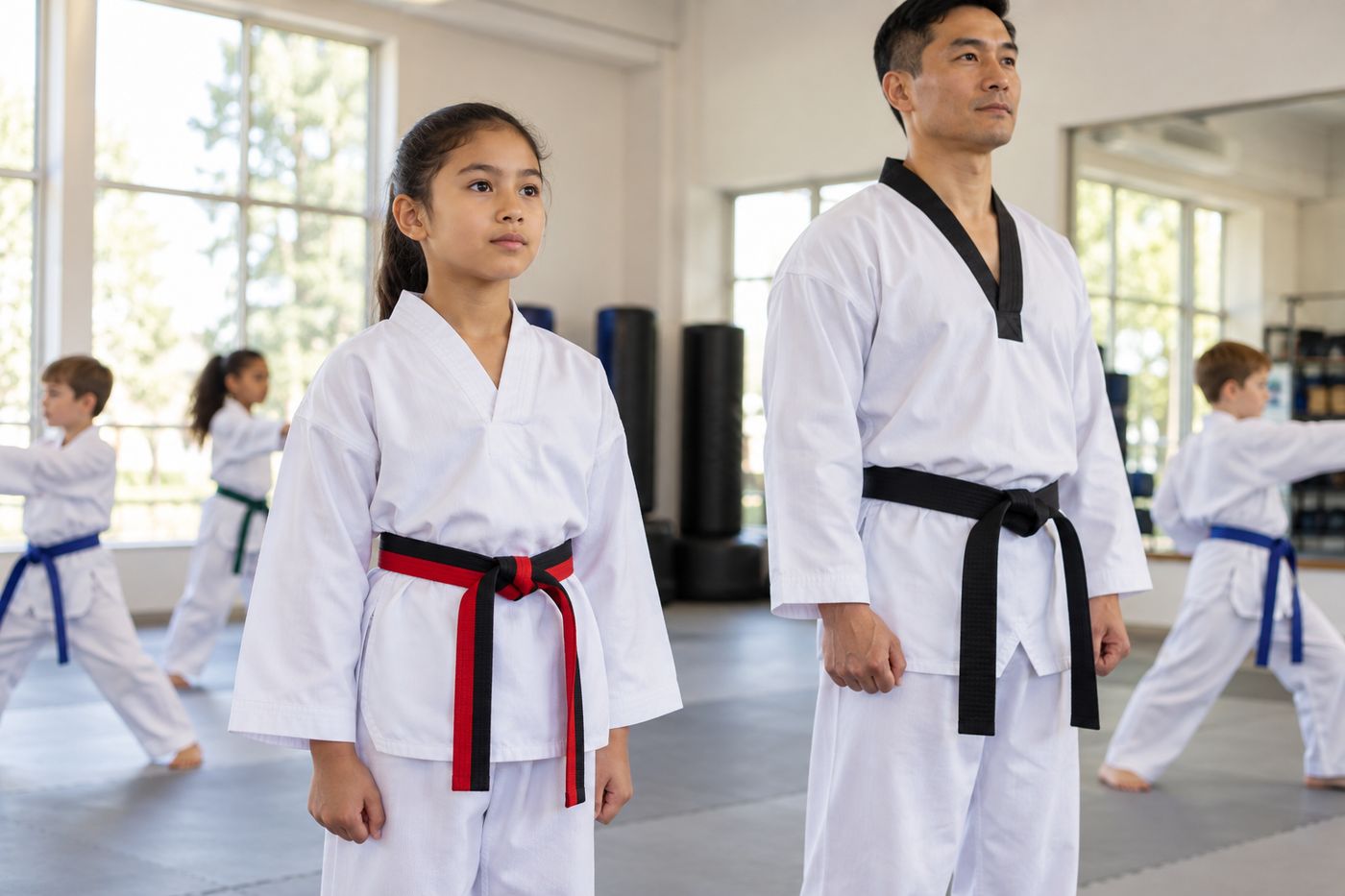
No. Red is the highest color belt and comes right before black. The half-red, half-black belt is a poom belt, the black belt for students under 15.