On this page
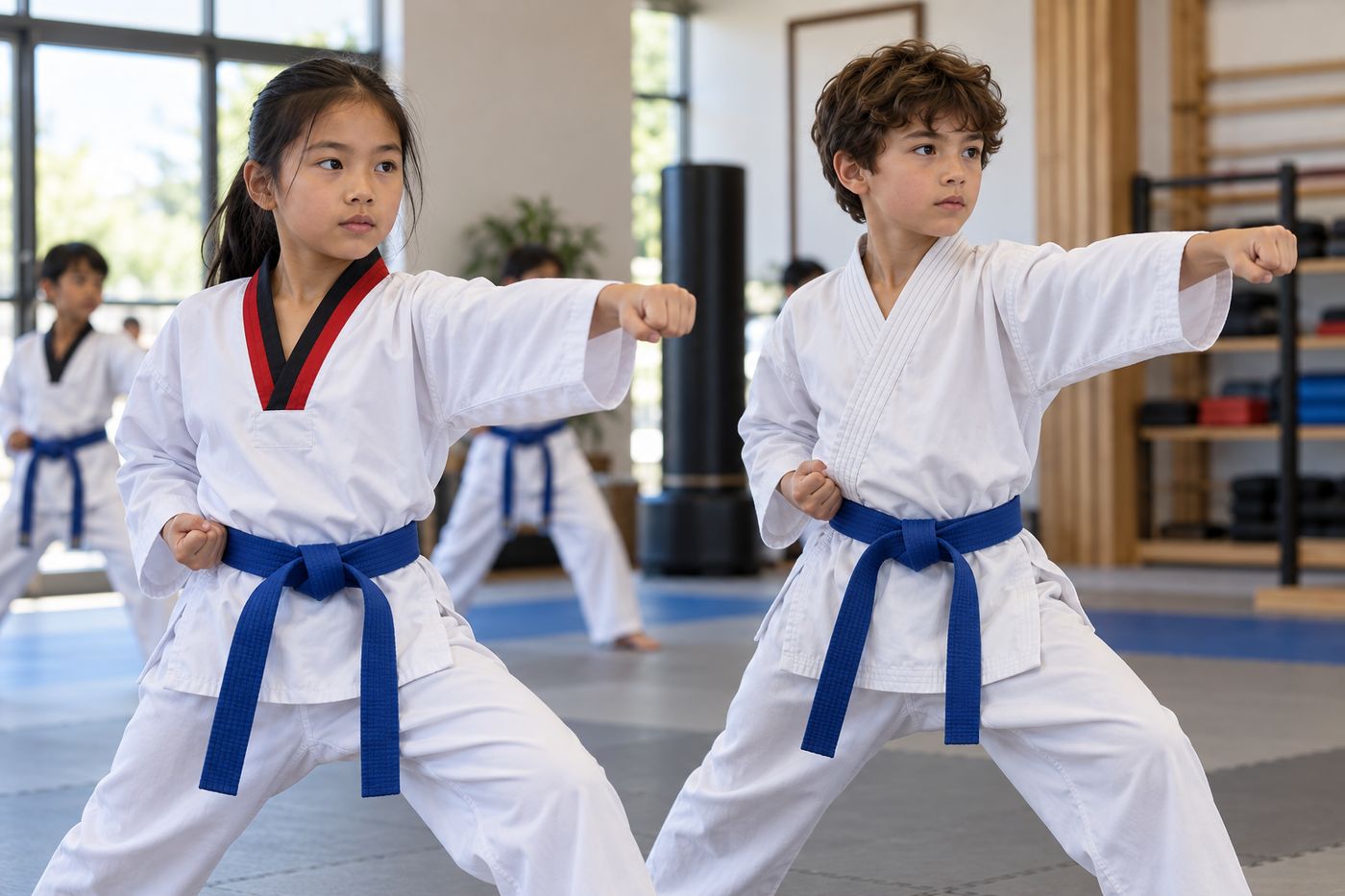
Blue belt is one of the six classic Taekwondo colors and, for many students, the most enjoyable stage of the color belts. The basics are solid, sparring is regular and the kicks get bigger and more spectacular. It is also the belt where instructors start to see who will make it to black belt, because blue belt asks for real commitment: more sparring, harder breaks and a form that demands control as well as power.
What the blue belt symbolizes
Blue stands for the sky. In the traditional story of the belts, the plant that sprouted at green is now growing tall and reaching up toward the sky. The student’s training is climbing higher too, with higher kicks, more difficult techniques and a better understanding of how Taekwondo works.
There is a second side to the image that instructors like to mention. The sky is wide open, and blue belt is where students start to see how much more there is to learn. It is a belt that should feel exciting rather than finished.
The attitude expected at blue belt
At blue belt, instructors look for courage and control together. Courage, because sparring is now a regular part of training and students are expected to step in against stronger partners, keep their guard up and not give up when they are hit. Control, because blue belts are strong enough to hurt someone, and the instructor wants to see that power used carefully, with clean contact in sparring and no showing off.
Blue belts are also expected to be reliable members of the class. They know the routines, they can lead a warm-up, and in many schools they start to be trusted with correcting a lower belt’s stance. Students who take that responsibility seriously tend to move up faster.
What a blue belt learns
Blue belt adds a step up in difficulty:
Spinning kicks. The spinning hook kick (dwi huryeo chagi) is the signature kick of many blue belts. It combines the turn of the back kick with the sweep of the hook kick, and it takes balance and timing.
Elbow strikes (palgup chigi) and other close-range techniques, used in self-defense and in the forms.
Breaking (gyeokpa). Board breaks get harder at blue belt, often with a spinning or back kick, or two boards for older students.
Strategy in sparring. Blue belts learn to set up kicks, to counter and to use footwork to control distance, rather than just exchanging kicks.
Taegeuk Yuk Jang, the sixth form, which introduces the single knife-hand high twist block, the palm-heel block and the roundhouse kick inside a form, along with a section performed stepping backward. See our step-by-step guide to Taegeuk Yuk Jang.
What is on the test for the next belt
A typical test from blue belt includes advanced basics, spinning kicks on pads, a review of all earlier forms with Taegeuk Yuk Jang, self-defense, several rounds of sparring, and a more demanding board break. Some schools also ask blue belts a few questions about the meaning of the forms or the tenets of Taekwondo.
Judges are looking for kicks that are both fast and controlled, and for a form performed with clear differences between fast and slow moves. In Yuk Jang, keeping balance when stepping backward is a common sticking point.
How long blue belt takes
Blue belt usually takes three to five months in a nine-color school, and longer in a six-color school where it covers two forms. Students who spar regularly often find blue belt passes quickly because the training is so varied.
Tips for parents and students
Blue belt is a good time for parents to talk with the instructor about the road to black belt. Ask what the remaining belts require and roughly how long they usually take at your school. Our guide to how long it takes to get a black belt can give you a reference point.
For students, spinning kicks get easier with a fixed spot to look at. Turn the head first, find the target over your shoulder, and let the body follow.
Next comes brown in many US schools, or red in six-color schools. For the full ladder of ranks, see Taekwondo ranks explained.
Questions parents and students ask
What does blue belt mean in Taekwondo?
Blue is the sky that the growing plant reaches toward. The student's training is now climbing higher, both literally, with higher and spinning kicks, and in skill and responsibility.
Is blue belt intermediate or advanced?
Blue is usually counted as upper intermediate. In a nine-color US school it is typically 5th geup, the middle of the ten color ranks. In a six-color school blue covers the 4th and 3rd geup area and is closer to advanced.
What form do blue belts learn?
In nine-color schools, usually Taegeuk Yuk Jang, the sixth form. In six-color schools, blue belts often learn both Oh Jang and Yuk Jang.