On this page
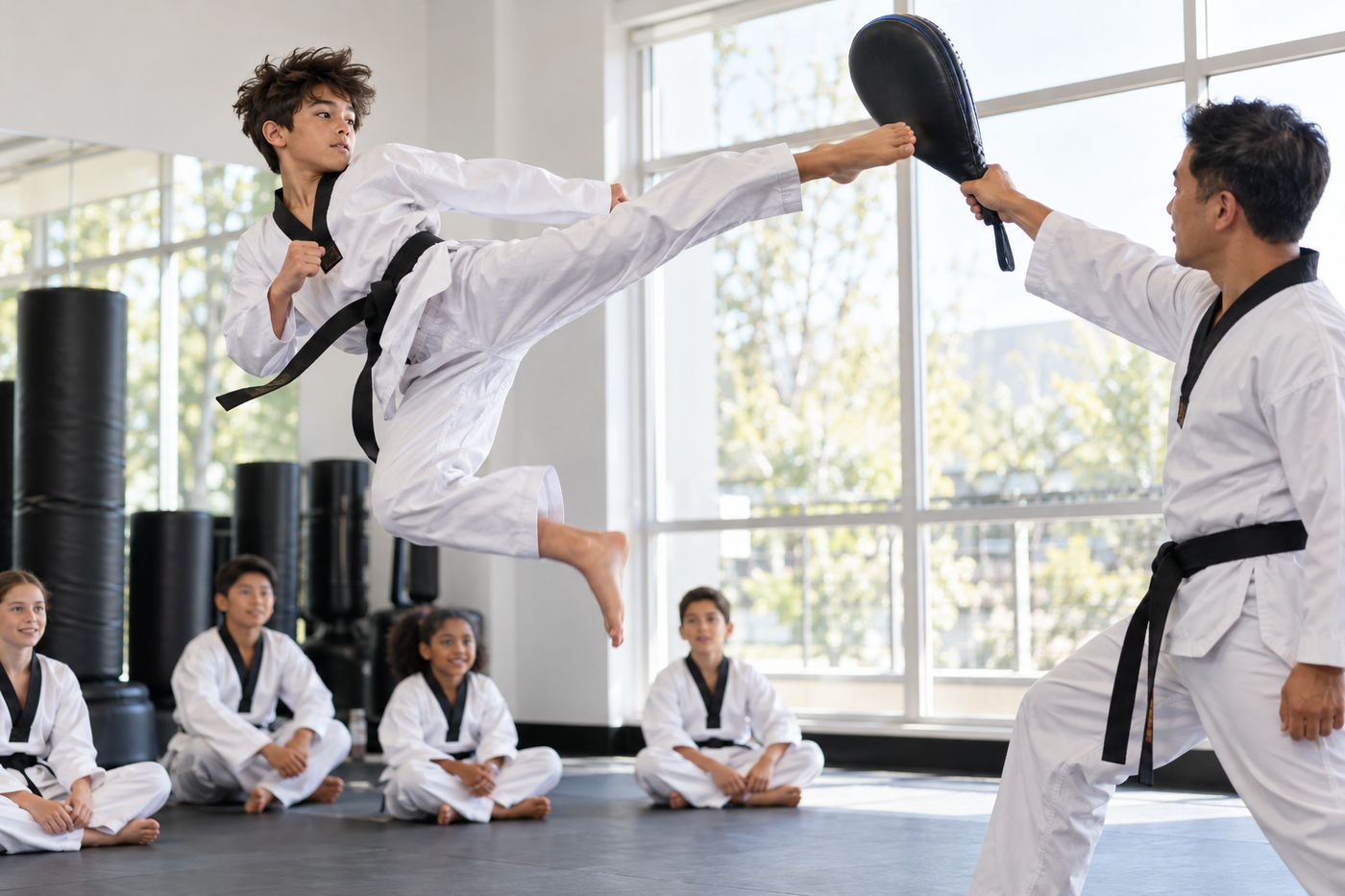
The jump spinning hook kick, ttwieo dwi huryeo chagi (뛰어뒤후려차기), is the spinning hook kick taken off the ground. The student spins, jumps and whips the heel around at head height or higher, landing back in stance. It is a demonstration-team favorite and a regular high-board break at black belt tests. It also has a reputation for injuries when students attempt it too early, so it is worth knowing exactly what has to be in place first.
What it is used for
In demonstrations and breaking, the jump spinning hook kick is used for boards held high, sometimes above the holder’s head. In sparring it is rare but valuable: as a turning kick to the head it scores the maximum 5 points under World Taekwondo rules. In black belt tests it shows that a student can combine rotation, height and accuracy.
How to do a jump spinning hook kick, step by step
- Start in a fighting stance, side-on to the target.
- Turn your head to look over your back shoulder and spot the target.
- Start the spin by pivoting on the front foot and turning your back toward the target.
- Drive the front knee up hard to lift into the jump while you keep spinning.
- In the air, extend the back leg out past the target and whip the heel around through it.
- Let the leg finish its arc and land on the non-kicking foot first, knees bent, facing the target.
The spin powers the kick. If you stop turning to jump, the kick loses all its speed.
The progressions to learn first
A clean spinning hook kick from the floor comes first, landing on target at chest height or above. Next comes a spinning hook kick with a small hop, so the standing foot leaves the floor briefly. After that, students add the knee drive for real height. Coaches often hold a target low at first and raise it as the kick gets cleaner.
Common mistakes
Jumping straight up and then spinning is the most common error. The spin and the jump should happen together. Second, many students lose the target mid-spin and the kick sails past. Spot early. Third, kicking with a bent leg shortens the reach and turns the kick into a flail. Extend the leg first, then whip. Last, landing on the kicking leg or with stiff knees is a common cause of injury. Land on the other foot and bend.
Practising safely
Practise on mats, after a full warm-up, with an instructor watching until the kick is consistent. At home, stick to floor-level spinning hooks, spin drills and gentle hops. Dizziness after several spins is normal; stop and rest when it happens.
Where it fits in your training
Most students learn the jump spinning hook kick at red belt or black belt. For the kicks that come before it, see the hook kick and spinning hook kick, and for every kick, the kicks guide.
Questions parents and students ask
What belt learns the jump spinning hook kick?
Usually red belt or black belt, after the standing spinning hook kick is consistent and on target. Many schools treat it as a black belt or demonstration-team skill.
Why does my jump spinning hook kick go too low?
Usually because the jump starts before the spin, or the leg is lifted late. Spin first, drive the front knee up for height, and extend the kicking leg as you rise.
Is it used in sparring?
Occasionally, as a spectacular counter that scores 5 points to the head, but it is risky because a miss leaves you exposed. It is far more common in demonstrations and breaking.