On this page
Every Taekwondo student starts in a white belt and works toward black, but the colors in between are less fixed than most parents expect. Two schools in the same town can use different orders, and a child who switches schools can find that their green belt “means” something else down the street. That is not a sign that either school is wrong. Taekwondo’s governing bodies set the ranks, while schools choose the colors that show them.
This guide walks through the order most Olympic-style schools use, what each color traditionally stands for, how the numbered ranks behind the colors work, and how to read your own school’s system when it looks different.
The standard Taekwondo belt order
The simplest and most widely recognized order has six colors, and it is the one you will see in most schools in Korea:
| Order | Belt | Korean | Typical forms learned |
|---|---|---|---|
| 1 | White | 흰띠 (huin tti) | Basics, then Taegeuk Il Jang |
| 2 | Yellow | 노란띠 (noran tti) | Taegeuk Il Jang and Ee Jang |
| 3 | Green | 초록띠 (chorok tti) | Taegeuk Sam Jang and Sa Jang |
| 4 | Blue | 파란띠 (paran tti) | Taegeuk Oh Jang and Yuk Jang |
| 5 | Red | 빨간띠 (ppalgan tti) | Taegeuk Chil Jang and Pal Jang |
| 6 | Black | 검은띠 (geomeun tti) | Koryo and the black belt forms |
Because there are ten color-belt ranks to fit into those six colors, most American schools stretch the list. A very common extended order is white, yellow, orange, green, purple, blue, brown, red, red-black (or “high red”), and then black. Other schools keep the six colors and add a stripe of the next color for the halfway point, so a student goes from yellow to “yellow with a green stripe” before earning a full green belt. Both approaches are describing the same ladder, just with different paint.
What each belt color means
The meanings below are the explanation most instructors give, and they come from the image of a seed growing into a tree. It is worth knowing that the Kukkiwon, which issues black belt certificates for Olympic-style Taekwondo, does not publish official color meanings. The International Taekwon-Do Federation (ITF) does, and the story below closely follows it, which is why it turns up in nearly every dojang.
White stands for innocence. The student has no knowledge of Taekwondo yet, and the plain belt is a fresh start. At this stage children learn to bow, stand at attention, count in Korean and hold their first stances.
Yellow is the earth in which a seed is planted. The first roots go down as the student learns the foundation: the first form, Taegeuk Il Jang, a solid front stance, low blocks and basic kicks.
Green is the plant beginning to grow. Techniques start to connect into combinations, and students learn back stance, knife-hand blocks and the side kick.
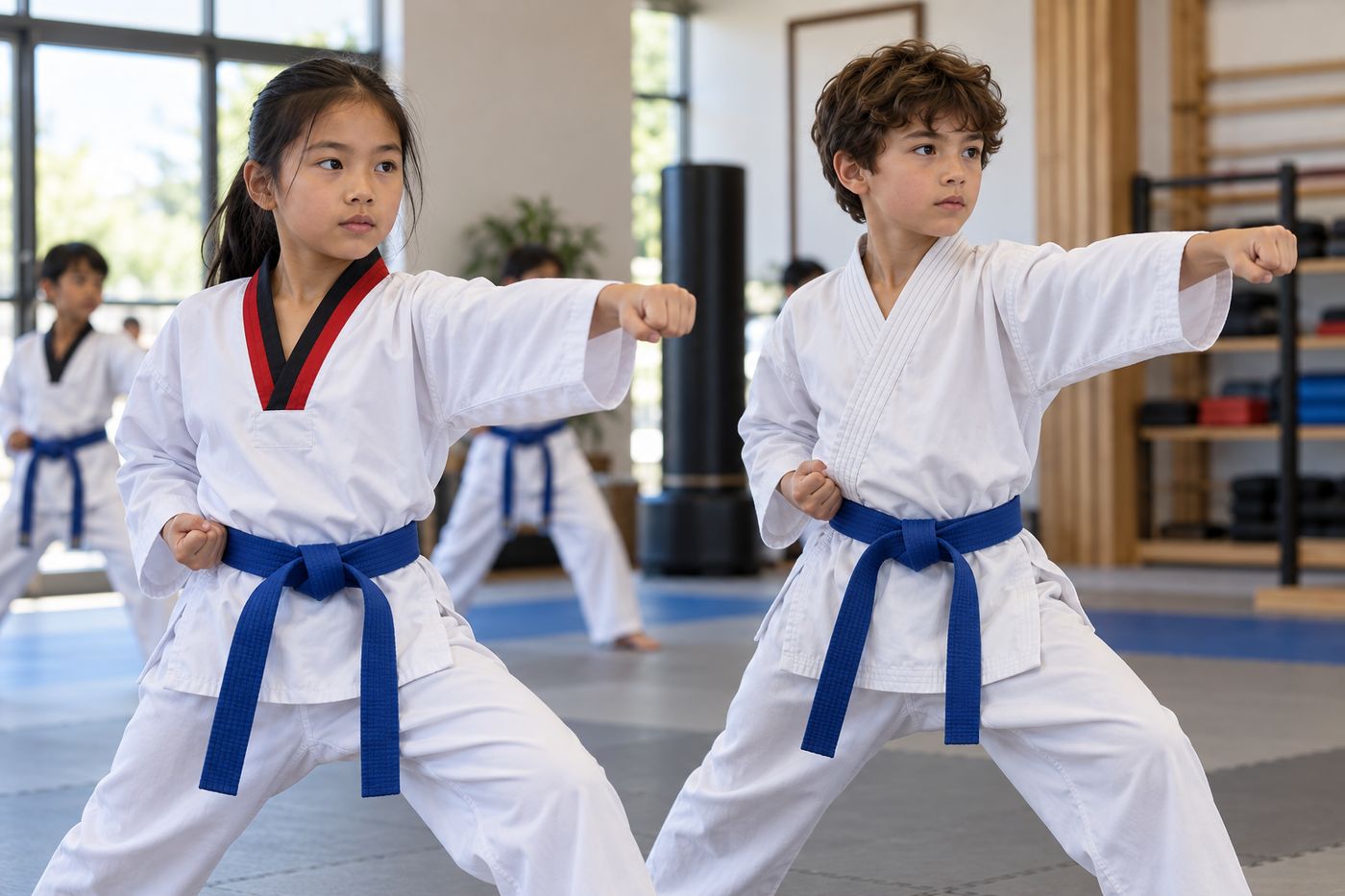
Blue is the sky that the growing plant reaches toward. Training climbs higher, with back kicks, hook kicks, elbow strikes and sparring in full protective gear.
Red is the color of danger and caution. The student now has skill that could hurt someone and must learn the control to use it responsibly. Red belts work on spinning and jumping kicks and begin preparing for the black belt test.
Black is the opposite of white. It stands for maturity and calm, and for a student who is no longer afraid of the dark. Instructors like to point out that a black belt is less an ending than a new beginning, because the first degree is where serious study of the art really starts.
Each color has its own page with what it symbolizes, the attitude instructors expect and what is usually on its test, including the orange, purple and brown belts that many US schools add.
Geup, poom and dan: the numbers behind the colors
Behind every color is a number, and the number is what actually counts on paper. Color-belt ranks are called geup (급, often spelled gup or kup on certificates), and they count downward. A brand-new student is 10th geup, and the last rank before black belt is 1st geup. That is why a red belt who is about to test is sometimes called “first gup” in class.
Once a student passes the black belt test, the counting flips and goes up. Adults and teenagers aged 15 and over earn dan (단) degrees, from 1st dan to 9th dan. Children under 15 earn poom (품) degrees instead, from 1st to 4th poom. A poom is a full black belt rank with the same test and the same forms, and it is registered with the Kukkiwon in the same way. The difference is the belt itself: a poom belt is half red and half black along its length, and it converts to the matching dan once the student turns 15.
Parents are often surprised by that red-and-black belt, and some worry their child was given a lesser rank. It is better to think of it the way you would think of a junior license. The skill is real, and the paperwork simply reflects that a ten-year-old black belt is still a ten-year-old.
How long each belt usually takes
Most schools test color belts every two to four months, so a child who trains two or three times a week typically moves through the color belts in two and a half to four years. The early belts come fastest because the material is simpler, while the jump from red belt to black usually takes the longest, often six months to a year of focused preparation. Adults move at a similar pace, although work and family schedules make the range wider.
If your school promotes much faster than this, for example a black belt in under eighteen months, it is worth asking how often students train and what the black belt test includes. If it is much slower, ask what the requirements for the next test are so your child has a clear target. Our guide to how long it takes to get a black belt goes through the numbers in detail.
Why your school’s belt order looks different
There are three common reasons a belt system you see in person won’t match a chart online.
The first is the style of Taekwondo. Olympic-style schools follow the Kukkiwon and World Taekwondo, and they use Taegeuk forms. ITF schools use a different set of patterns and add a stripe, sometimes called a tip, to each belt halfway through: white, white with yellow stripe, yellow, yellow with green stripe and so on. The ATA (American Taekwondo Association) uses its own colors, including orange, camouflage and a “recommended black belt” stage, and its own forms.
The second is the school’s own preference. Because the Kukkiwon only registers black belt ranks, each school is free to decide how it shows the ten geup ranks. Some add colors to give children more frequent rewards, some use stripe tape on the belt end to mark progress between tests, and some keep the classic six colors.
The third is age. Many schools run a separate “little dragons” or “tiny tigers” program for children around four to six, often with its own belt colors or stripes, before moving them into the regular system.
The best way to read your own school’s system is to ask for the curriculum sheet. Most schools have one listing every belt, its geup number and the form required to test for it, and once you know which belt equals which geup, you can match it to any chart, including the one above.
Belt stripes and tape
Colored tape or stitched stripes on the end of the belt usually mark progress between tests rather than a new rank. A school might give one stripe for learning the new form, one for the required kicks and one for attendance, and a student with all three is ready to test. These stripes are entirely school-specific, so if your child comes home with a new stripe, the instructor can tell you what it was for. We explain the common systems in our guide to belt stripes, and the whole ladder from first stripe to 9th dan is laid out in Taekwondo ranks explained.
Questions parents and students ask
What is the correct Taekwondo belt order?
The most common order is white, yellow, green, blue, red, then black. Many schools add orange, purple, brown or striped belts in between, so a full sequence can have ten or more colors before black.
What belt comes after yellow in Taekwondo?
In the simple six-color system, green comes after yellow. Schools with more colors often put orange or a yellow belt with a green stripe in between.
Is red higher than black in Taekwondo?
No. Red is the last color belt before black. A belt that is half red and half black is a poom belt, the junior black belt worn by students under 15.
How many belts are there in Taekwondo?
There are ten color-belt ranks, called geup, from 10th up to 1st, followed by nine black belt degrees. How many different colors a school uses to show those ten geup ranks is up to the school.