| Japanese | Meaning | |
|---|---|---|
| Rei | ray | Bow |
| Onegaishimasu | oh-neh-guy-shee-mas | Please (teach me), said at the start |
| Arigato gozaimashita | ah-ree-gah-toh go-zai-mash-ta | Thank you, said at the end |
| Yoi | yoy | Ready |
| Hajime | ha-jee-meh | Begin |
| Yame | yah-meh | Stop |
| Kiai | kee-eye | The short, loud shout on a technique |
| Osu | oss | Yes, I understand (used in some styles) |
On this page
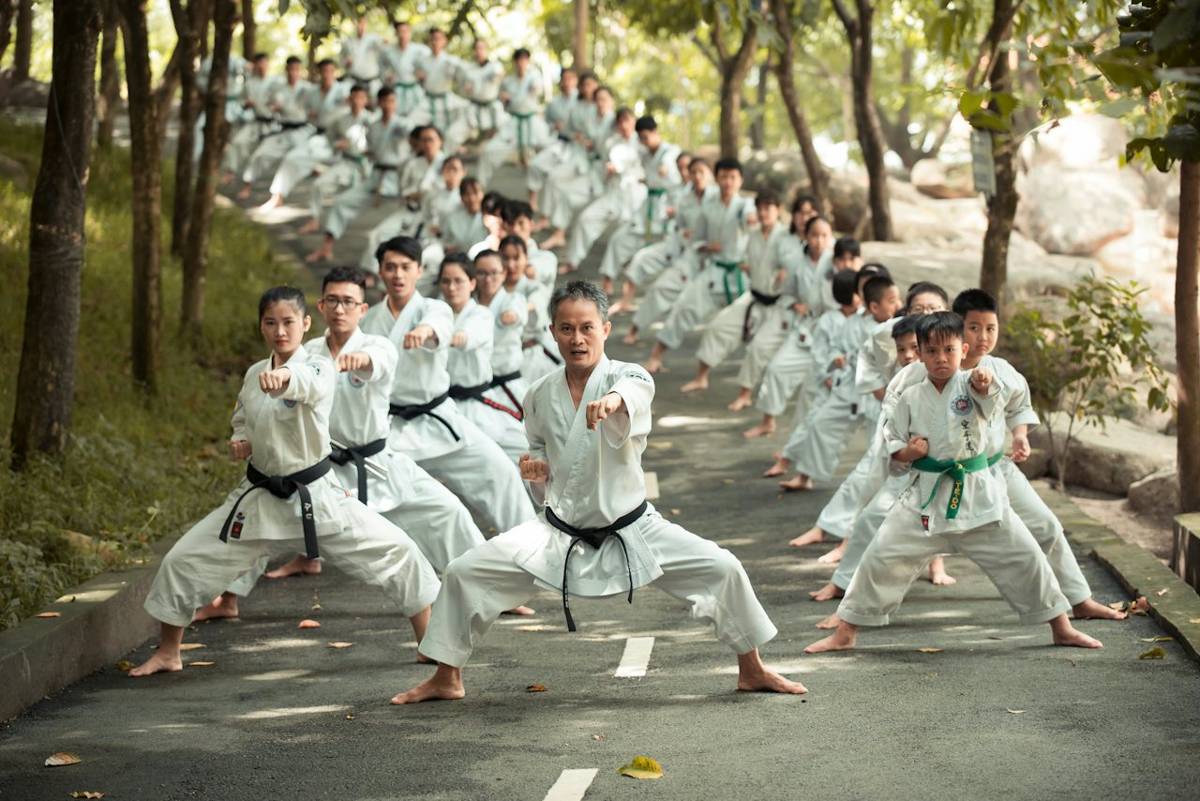
Within a few weeks of starting karate, children come home saying words like hajime, kiai and zenkutsu dachi, and parents are left guessing. Karate developed in Okinawa and Japan, and most schools still use Japanese for commands, counting and technique names. You do not need to learn them all, but knowing the basics helps you follow what your child is doing and practise with them at home. Pronunciation and usage vary a little between styles and schools, so always follow your child’s sensei.
Greetings and class commands
The table above lists the words heard in almost every class. Class begins with rei, a bow, and often onegaishimasu, a polite phrase meaning roughly “please teach me”. It ends with another bow and arigato gozaimashita, “thank you very much”. During class, the instructor uses yoi (ready), hajime (begin) and yame (stop). In many schools children kneel in seiza, a formal kneeling position, at the start and end, and close their eyes for mokuso, a moment of quiet.
People and places
Sensei means teacher and is how children address the instructor. Sempai is a senior student and kohai a junior one. The training hall is the dojo, the uniform is a gi or karategi, and the belt is an obi. The front wall of the dojo, often with a flag or photo of the style’s founder, is called the shomen.
Counting to ten
Children count in Japanese during drills and warm-ups: ichi (1), ni (2), san (3), shi (4), go (5), roku (6), shichi (7), hachi (8), ku (9), ju (10). Many schools say yon for four, nana for seven and kyu for nine instead, because shi and ku can sound like Japanese words for death and suffering. Either is correct.
Techniques
Most technique names combine a target or direction with the type of move. Zuki (or tsuki) means punch, so oi zuki is a lunge punch and gyaku zuki a reverse punch. Geri means kick: mae geri is a front kick, yoko geri a side kick, mawashi geri a roundhouse kick and ushiro geri a back kick. Uke means block: age uke is a rising block, gedan barai a downward sweeping block and soto uke an outside block. Dachi means stance: zenkutsu dachi is the long front stance, kiba dachi the horse-riding stance and kokutsu dachi the back stance.
Training words
Kihon means basics, kata the set routines, and kumite sparring. Kiai is the short, loud shout children give on certain techniques; it helps breathing, focus and power, and most children love it. Our guides to karate belts and kata and karate sparring rules explain kata and kumite in more detail.
Helping your child learn
Ask your child to teach you the counting, or call out a few commands while they practise at home; our guide to karate home practice has simple drills. Learning the words is part of the fun, and children often take real pride in knowing them.
Questions parents and students ask
What does osu mean in karate?
Osu is an all-purpose word used in some karate styles, especially Kyokushin and Shotokan schools, to mean yes, I understand, or as a greeting. Other schools rarely use it. Follow what your child's dojo does.
How do you count to ten in Japanese for karate?
Ichi, ni, san, shi, go, roku, shichi, hachi, ku, ju. Some schools say yon for four, nana for seven and kyu for nine.
What is the difference between sensei and sempai?
Sensei means teacher and is used for the instructor. Sempai means a senior student, someone who has trained longer and often helps newer students.