On this page
The first month of Taekwondo is mostly about learning how class works. Your child will kick and punch, of course, but the bigger lessons are how to line up, how to bow, how to answer an instructor, and how to keep going when a drill gets tiring. If you know what to expect, those first few weeks are much easier to support from the lobby.
Before the first class
Most schools offer a free or low-cost trial class. Your child can wear a T-shirt and athletic pants, and should come with hair tied back, nails trimmed and jewelry left at home. Taekwondo is trained barefoot, so shoes come off at the door, and many schools have cubbies or a rack by the entrance. Bring a water bottle with the child’s name on it.
Arrive ten minutes early. The front desk will want a waiver signed, and an instructor will usually spend a minute with your child before class, showing them where to stand and how to bow. That short welcome makes a big difference for nervous children.
Week one: bowing, lines and listening
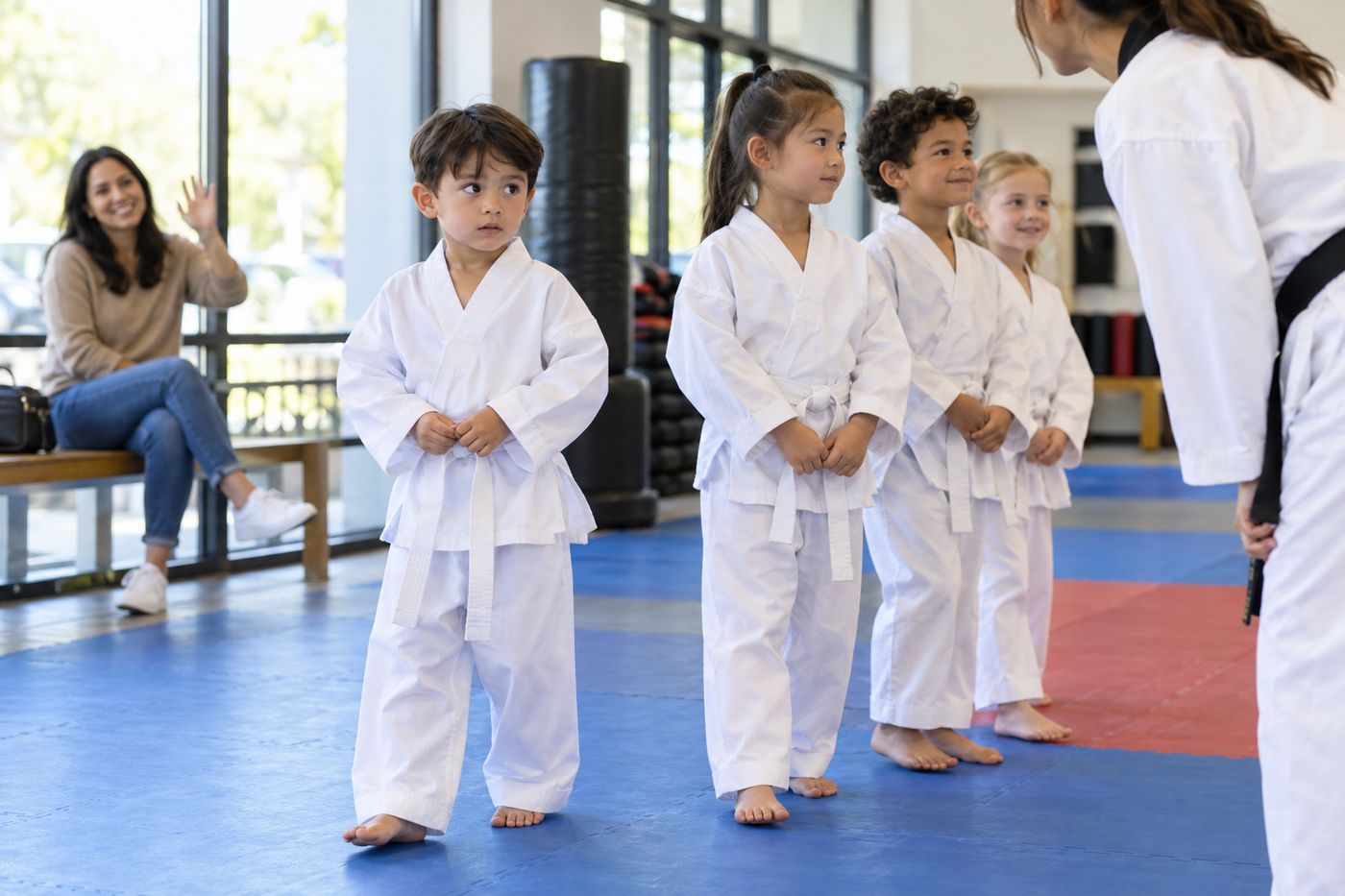
Class starts with students lined up by rank, highest belts at the front, white belts at the back. The instructor or a senior student calls charyeot (차렷, attention), and everyone stands straight with feet together and fists at their sides. Then comes gyeongnye (경례, bow), a bow from the waist toward the instructor, and the instructor bows back. Some schools also bow toward the flags at the front of the room.
That routine repeats at the end of class, and it is the heart of Taekwondo etiquette. Children learn to answer the instructor with “Yes, sir” or “Yes, ma’am,” or by calling the instructor sabeomnim (사범님), the Korean title for a master instructor. It can feel formal at first, but most children take to it quickly, because the rules are clear and everyone follows them.
The physical side of the first week is simple: a warm-up with jumping jacks and stretches, the ready stance, a front stance, a low block, a middle punch and a front kick. Expect the punches to be wild and the kicks to be enthusiastic. Accuracy comes later.
Weeks two and three: counting and the first form
By the second week, children are counting in Korean during drills: hana, dul, set, net up to yeol (ten). They will also start hearing the commands junbi (ready), sijak (begin) and baro (return). You may hear your child counting in Korean at bath time, which is a good sign. Our Korean terms list has every word with audio, if you want to practice together.
Many schools introduce the first form, Taegeuk Il Jang, around now, or a simpler basic pattern for very young students. A form is a fixed sequence of moves, and it is the part of Taekwondo that most resembles learning a short dance. Children who struggle with it in class often get it at home with a parent calling out the steps.
Week four: the first stripe and the first wobble
By the end of the month, many children earn their first stripe, a piece of colored tape on the end of the belt that shows progress toward the first test. Our guide to belt stripes explains what they usually mean.
Week four is also when the novelty wears off for some children. The class that felt like a party now involves repetition, and the child may say they don’t want to go. This is normal, and it is not usually a sign that Taekwondo is the wrong activity. Most instructors suggest keeping attendance steady for at least the first test cycle, then deciding. Children who stick it out through the first belt test usually get a big confidence lift from it.
What to buy, and what not to buy yet
In the first month, you need very little. Most schools include the first uniform, called a dobok (도복), and white belt with enrollment, or sell a set for around $30 to $60. Don’t buy sparring gear yet. Schools usually wait until yellow or green belt before starting contact sparring, and many require a specific brand or color, so ask before you buy.
A few things do help from the start: a bag to keep the uniform in, a water bottle, and a habit of hanging the uniform up after class instead of leaving it in the bag.
How to tell if it’s going well
Look for small signals. Does your child talk about class on the way home, show you a new kick in the kitchen, or remember the instructor’s name? Do they stand a little straighter when lined up? Those are better signs than perfect technique.
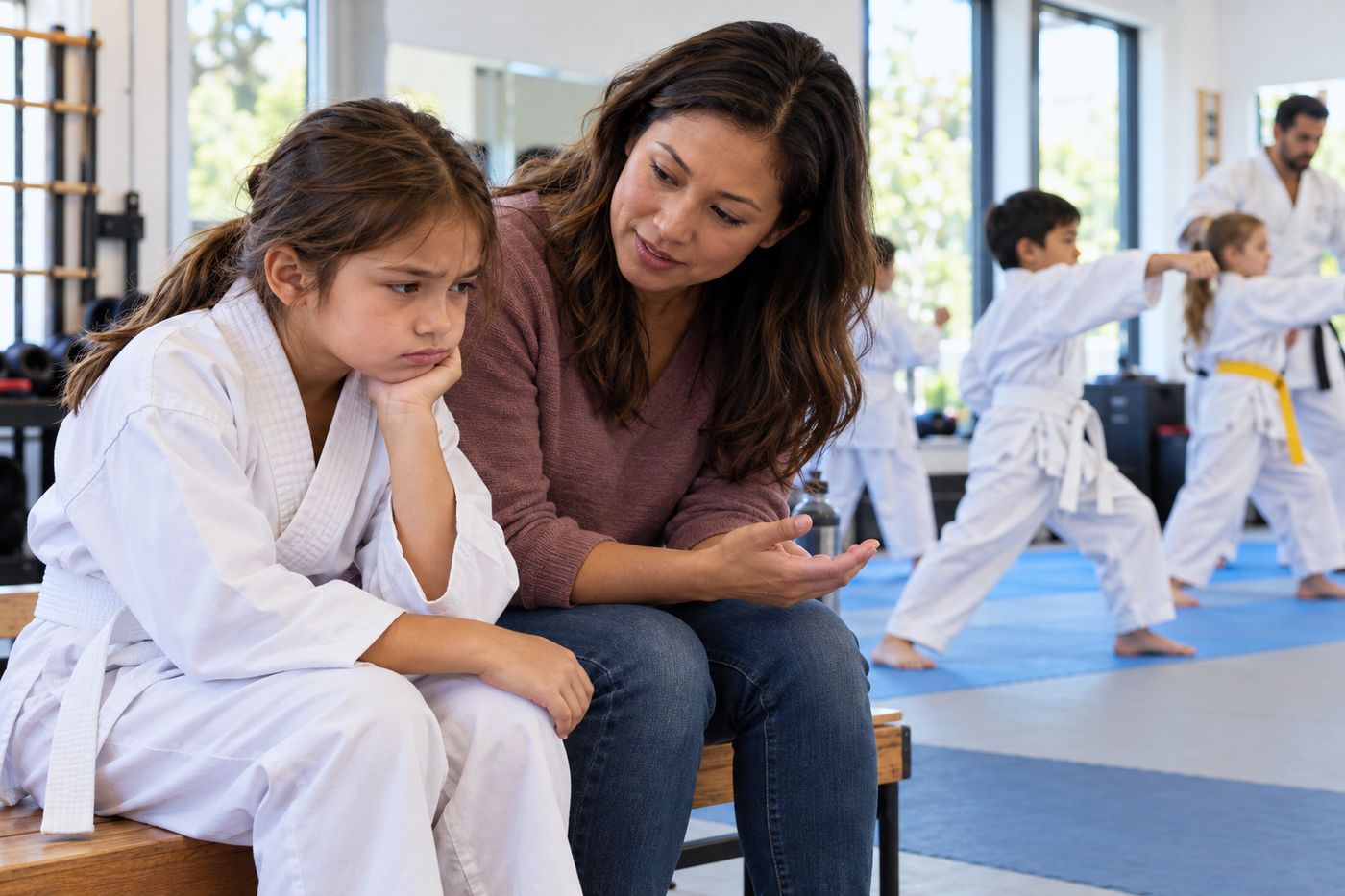
If your child seems anxious, talk to the instructor. Good schools have seen every kind of first month and will pair a shy child with a friendly senior student, let them start at the end of the line, or give them a small job like holding a target. The goal of the first month isn’t a perfect front kick. It’s a child who wants to come back next week.
Questions parents and students ask
What should my child wear to the first Taekwondo class?
Comfortable athletic clothes such as a T-shirt and sweatpants are fine for a trial class. Training is barefoot, so no shoes or socks on the mat. Most schools sell the uniform, or dobok, once you enroll.
How long is a kids Taekwondo class?
Most children's classes run 40 to 60 minutes. Classes for four- to six-year-olds are often 30 to 45 minutes with lots of games.
Should parents watch Taekwondo class?
Most schools welcome parents in the lobby or a viewing area. Watching quietly is fine; coaching your child from the side usually distracts them and the class.
When does a child get their first stripe or belt?
Many schools give a first stripe within two or three weeks and hold the first belt test after two to three months.